Science & Technology · Shenzhen Event Notes
Can Flying Cars Really Take Off? Energy, Propulsion and Commercialization
What would it take for a flying car—or even a flying board—to stay airborne safely, efficiently and affordably? A Shenzhen technology event offered a useful starting point for thinking beyond the spectacle.
From advanced materials to intelligent mobility
On October 25, I attended From Materials to Intelligence: Frontier Innovation and Industrial Integration in New Energy Technology, a discussion co-organized by Tsinghua alumni groups, the University of Hong Kong Pearl River Delta alumni community and the University of Milan Shenzhen alumni community, according to the event information.
The program featured Professor Zhigang Chen joining online from Australia; Rongjie He, a Tsinghua-trained researcher and founder and CEO of Qinghang Shidai, speaking in person; and Jinqi Liu, formerly responsible for AI strategy and planning at Geely, joining online. The sessions spanned advanced materials, energy conversion, flying-vehicle power systems and intelligent mobility.
The question I kept returning to was practical: how do we move from an impressive flying prototype to a product that people can actually use?
1. The first challenge is not flying—it is staying airborne
Short demonstrations can make personal flight appear deceptively simple. But lifting a person and a vehicle for a few seconds is fundamentally different from maintaining controlled flight with useful range, acceptable noise, redundancy and safe landing capability.
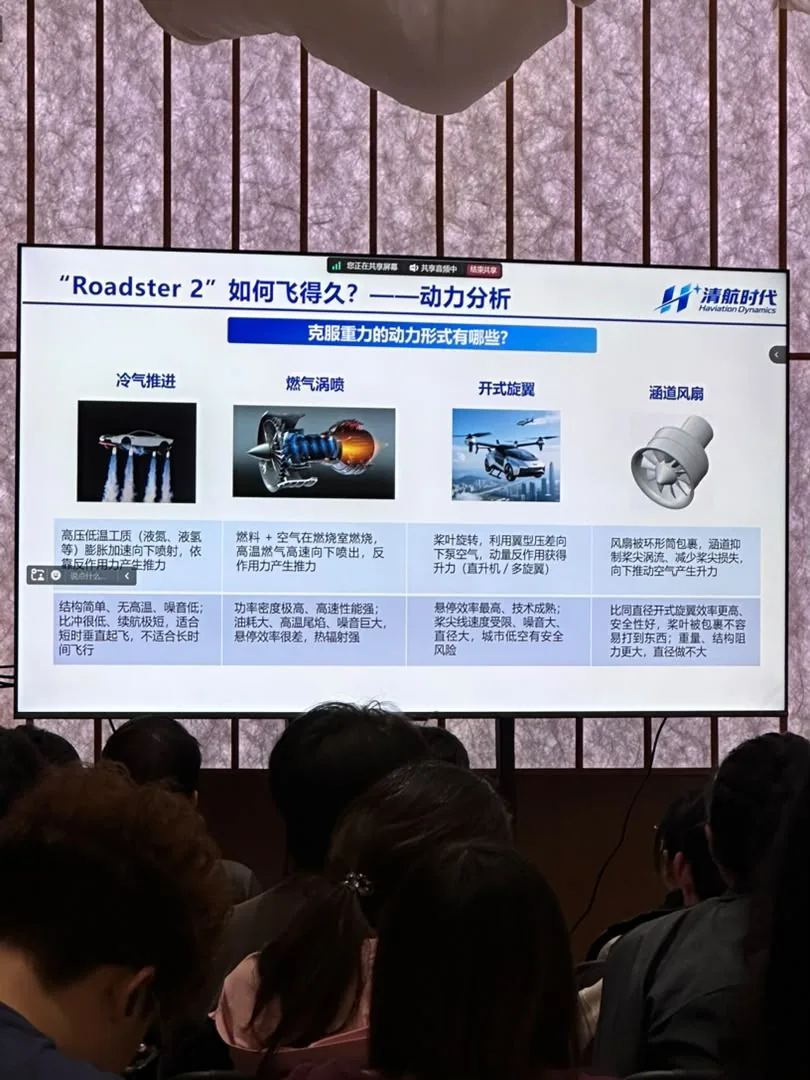
One presentation compared four thrust-producing approaches: cold-gas propulsion, fuel-burning turbojets, exposed rotors and ducted fans. They differ greatly in endurance, controllability, efficiency, noise and integration challenges.
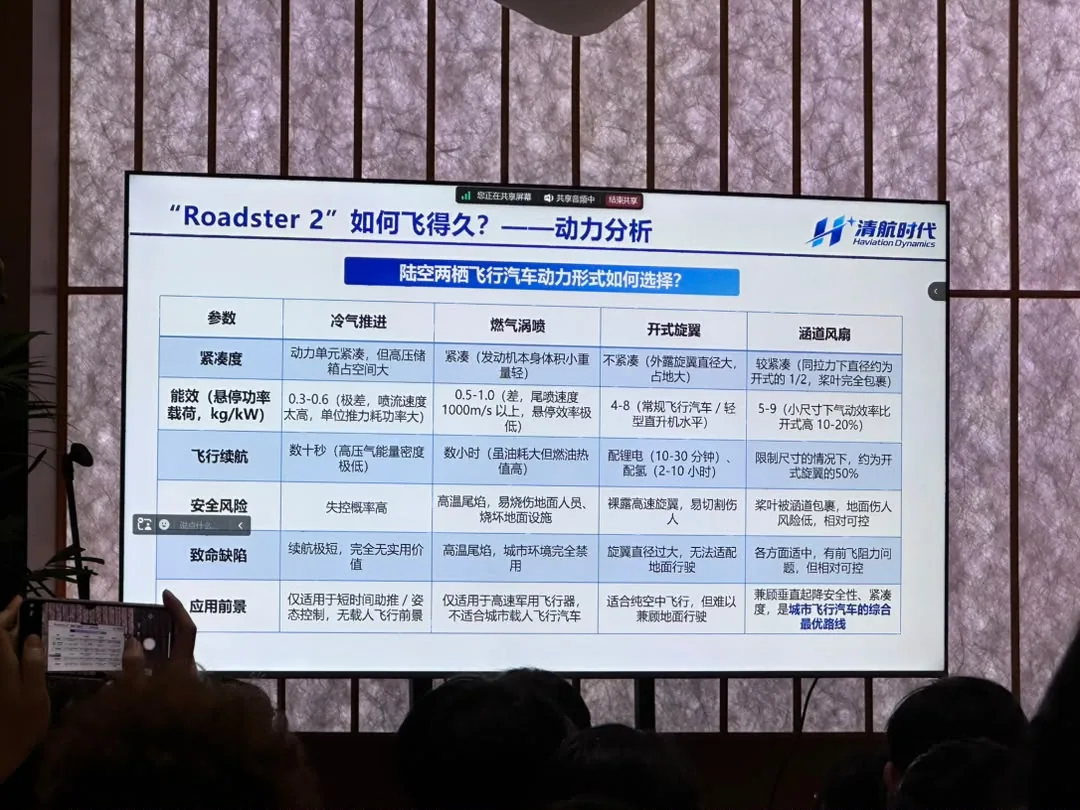
| Approach | Potential appeal | Key obstacle |
|---|---|---|
| Cold-gas thrust | Simple, rapid bursts of force | Very limited stored propellant and endurance |
| Turbojet | High power density | Heat, noise, fuel consumption and safety |
| Open rotor | Relatively efficient lift generation | Exposed blades, noise and operational safety |
| Ducted fan | Compact integration and some blade shielding | Weight, duct design and system-level efficiency trade-offs |
No propulsion system is universally best. A compact flying board, an electric vertical-takeoff aircraft and a road-capable flying vehicle may need very different solutions.
2. Energy storage is not the same as propulsion
The next part of the discussion concerned energy pathways: liquid hydrogen, fuel cells, electric motors and advanced materials. It is important to separate the roles they play. Energy storage determines what energy can be carried; conversion turns that energy into usable mechanical or electrical power; and propulsion creates the force that moves the aircraft.
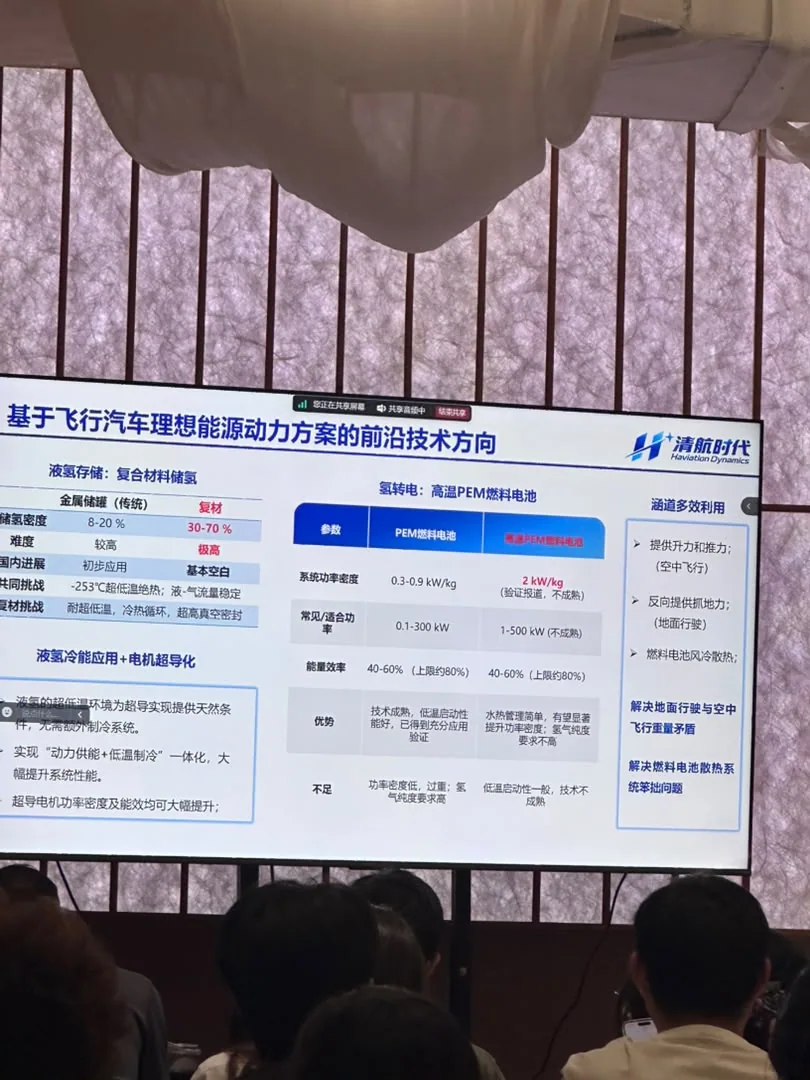
For example, a hydrogen-powered concept could store hydrogen, use a fuel cell to produce electricity and drive electric motors connected to fans. Another design could use batteries directly. Both require careful consideration of mass, cooling, peak power demand and failure modes.
Hydrogen is interesting because of its high gravimetric chemical energy, but storage tanks, insulation, balance-of-plant equipment and conversion losses matter. Liquid hydrogen also introduces demanding cryogenic storage requirements. Likewise, superconducting motors may offer future advantages in certain designs, but they add cooling and integration challenges. These are engineering trade-offs—not automatic solutions.
3. Why a flying prototype is not yet a mass-market product
Commercialization depends on far more than achieving takeoff. A viable product needs reliable manufacturing, maintainability, clear operating rules and a compelling use case.
Several questions stand out to me:
- Safety and certification: Can the vehicle handle motor failures, loss of power, adverse weather and emergency landing?
- Unit economics: What are the costs of the propulsion system, energy storage, maintenance, training and insurance?
- Infrastructure: Where can it take off, land, recharge or refuel?
- Supply chain: Can critical parts be produced consistently and inspected to aviation-grade requirements?
- Real demand: Does the vehicle solve a transport problem better than existing options?
A flying board designed for controlled demonstrations may reach a niche market sooner than a flying car intended for daily urban travel. But even niche applications need rigorous risk controls and a sustainable operating model.
4. A supply-chain perspective on advanced mobility
My professional interest in sourcing, manufacturing and international business makes the industrial side of these ideas particularly compelling. A flying vehicle combines systems from several supply chains: advanced materials, precision manufacturing, batteries or hydrogen systems, power electronics, motors, sensors, software and safety-critical components.
For manufacturers and suppliers, the key opportunity may not be to build an entire flying car. It may be to solve one difficult, measurable problem—for example, lightweight structural parts, thermal management, high-reliability connectors or traceable component quality.
However, supplying experimental mobility projects is not equivalent to supplying certified aviation programs. Qualification, testing, documentation and regulatory expectations can be substantially more demanding.
5. What I took away
What stayed with me was not a prediction that flying cars will soon become commonplace. It was a more useful way to evaluate emerging technologies: separate what can be demonstrated, what can be engineered reliably, and what can be commercialized economically.
The gap between these stages is where many of the most important technical and business questions lie.
For me, attending events like this is a way to keep learning across disciplines—and to better understand how scientific research, manufacturing capability and real-world demand eventually meet.